Blog
What’s Past Is Prologue
16 September 2026
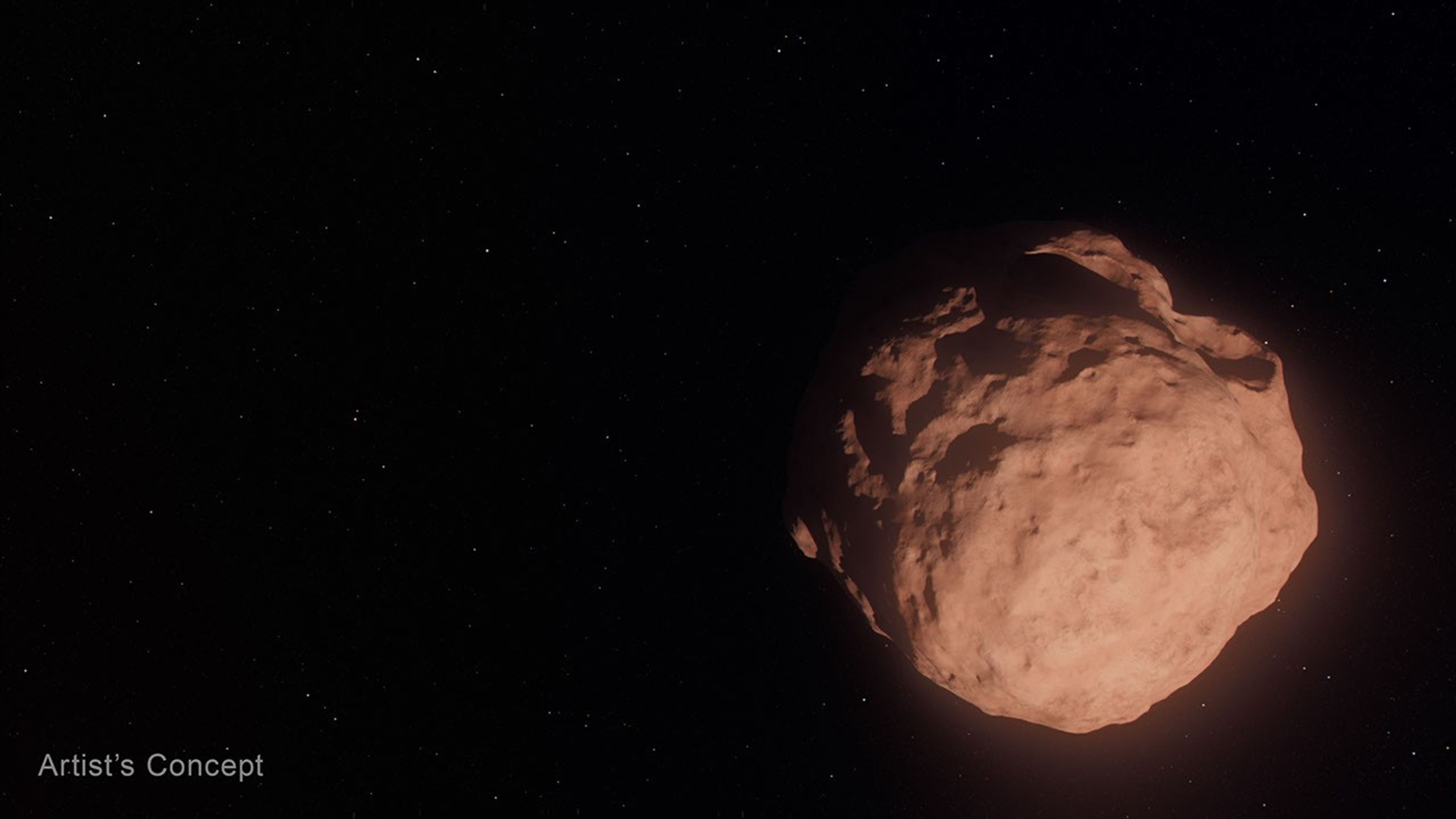 NASA, ESA, Leah Hustak (STScI)
The formation of our solar system was a complex process, but there are two things we know quite well. The first is that where a body forms has a significant effect on its composition. The icy giants of Neptune and Uranus formed at the outer region of the solar system, beyond the snow line. Earth and Venus formed close to the Sun, where solar winds stripped their atmospheres of hydrogen and helium.
The second is that where a body forms isn’t where it necessarily stays. Jupiter and Saturn migrated inward as they formed. They were closer to the Sun until the Great Migration shifted them to their present orbits. This planetary realignment also triggered the Late Heavy Bombardment period about 4 billion years ago, when Earth experienced some of its largest impacts.
It has been generally thought that planetary bodies maintain their original composition throughout their lifetime, but that small solar system bodies can change. Since small bodies are tossed about by the gravity of planets, they would shift more dramatically and experience more collisions. This, it was thought, would erase much of their original compositions. But two new studies overturn this idea.
Both of these studies focus on Trans-Neptunian Objects (TNOs), which currently orbit way beyond Neptune. Dwarf planets such as Pluto and Eris are TNOs, but most are tiny bodies. Because of their size and distance from the Sun, TNOs are faint and difficult to study. Using data from the James Webb Space Telescope (JWST), the first study looks at the surface colors and luminosities of TNOs.1 The second study uses JWST and Hubble data to study the size distribution of TNOs.2
There are two broad types of TNOs. Cold TNOs formed near their current locations at the edge of the solar system. Their orbits are generally circular and in the same orbital plane as the planets. Hot TNOs formed in the region between the present orbits of Uranus and Neptune. During the planetary migration, they were driven to the outer solar system. Their orbits tend to be elliptical and tilted away from the orbital plane. Statistically, it is easy to distinguish between these two types. The dwarf planet Eris is the largest hot TNO, while Makemake is a large cold TNO.
Cold TNOs generally have a reddish surface coloring, while warm TNOs have a broader distribution of colors. The studies found that this distinction remains true even for the smallest TNOs. Although hot and cold TNOs now orbit at similar distances from the Sun, the history of their origin is still written in their coloring. The studies also found that the size distributions of hot and cold TNOs are quite similar. This suggests that both groups have experienced similar rates of collisions over their lifetimes. The process of driving hot TNOs to the outer solar system wasn’t violent.
Another discovery of this research is that there are fewer small TNOs than planetary formation models predict. This could explain why the two TNO types retain their history, but it also raises questions about how these small bodies formed. There are more small TNOs waiting to be discovered and more stories they have to tell. What’s past is prologue to discoveries yet to come.
Morgan, Anastasia N., et al. “Combined JWST and HST Deep Imaging to Characterize the Smallest Known Trans-Neptunian Objects.” The Astronomical Journal 172.4 (2026): 188. ↩︎
Eduardo, Marielle R., et al. “The Luminosity Function of Ultrafaint Trans-Neptunian Objects Detected by JWST.” The Astronomical Journal 172.4 (2026): 187. ↩︎