Blog
Tale of a Centaur
3 September 2026
 International Gemini Observatory/NOIRLab/NSF/AURA
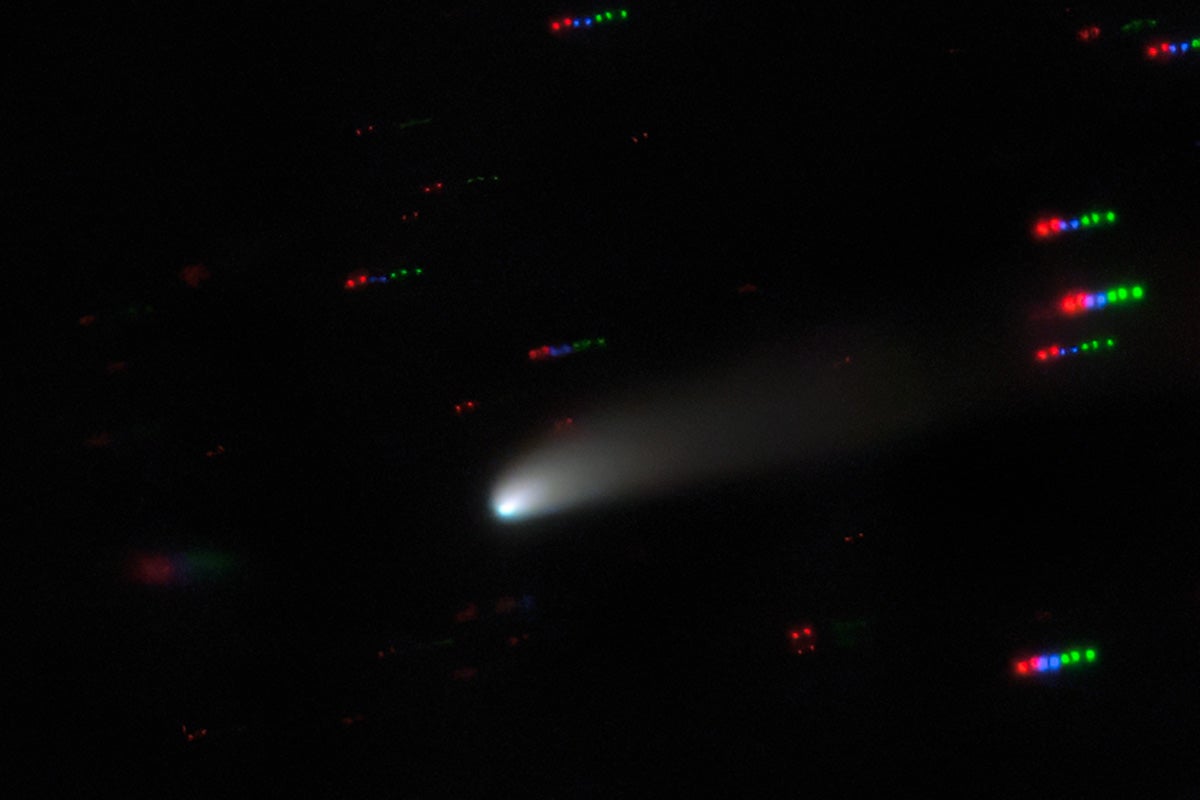
Centaurs are small solar system bodies that orbit the Sun between Jupiter and Neptune. Because they move among the gas giants, their orbits are generally unstable. Gravitationally nudged to and fro until they either tumble toward the inner solar system or are tossed away to the cold of deep space. Centaurs also straddle the gap between asteroids and comets. They aren’t as rocky as the warm bodies of the asteroid belt, nor are they as icy and dormant as cold Kuiper Belt objects. Because of this, studying Centaur objects is a good way to study how icy bodies become comets, as a recent study shows.1
 Schambeau, et al.
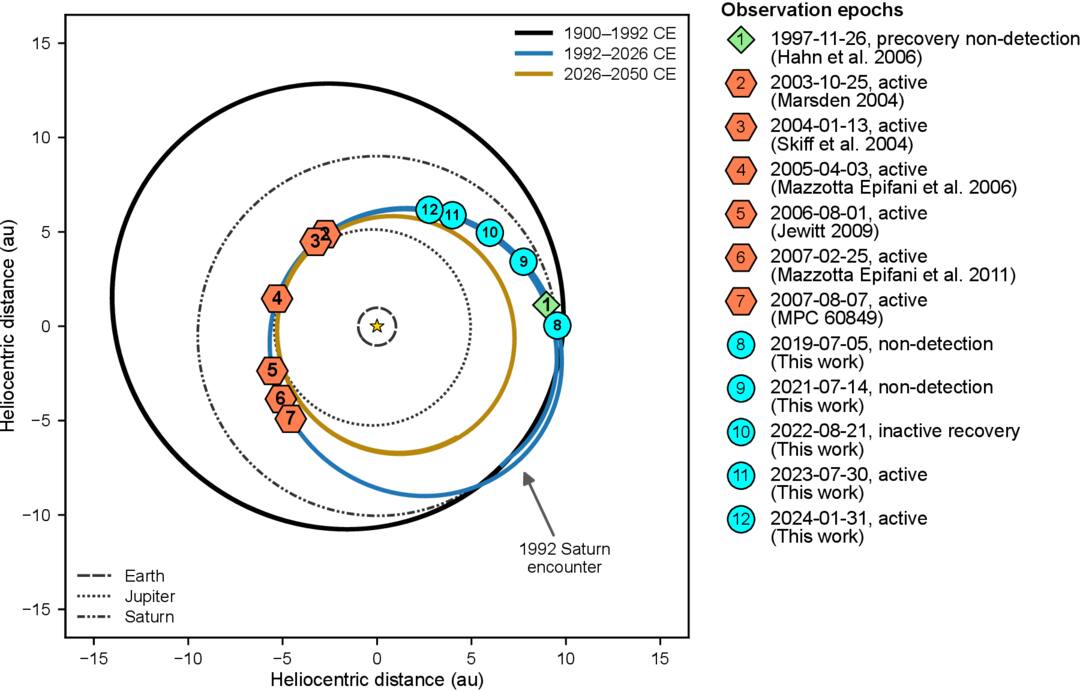
For this study the team used the James Webb Space Telescope and Gemini North observatory to observe a Centaur object known as 450P/LONEOS. This particular object had a close encounter with Saturn in 1992 that significantly changed its orbit. As a result, it reaches the orbital distance of Jupiter at perihelion. So Centaur 450P/LONEOS has become active, with a vapor and dust tail like other comets. You could say the object is transitioning into a cometary body.
As Centaur 450P/LONEOS moved toward its new perihelion, observations showed how it started venting volatile gases and how its tail started to form. When the team took spectral observations of this new tail, they found it had almost no water vapor. This is surprising, because we often think of comets as “dirty snowballs.” You would expect water vapor to be the most prominent volatile gas.
Instead, the team found a strong presence of carbon dioxide. It seems that dry ice is what drives a body’s transition to a comet. One possibility is that much of the ice in Centaur 450P/LONEOS is in an amorphous, porous form. As it starts to warm, the water ice forms into ice crystals and releases carbon dioxide. This idea is supported by observations of the object’s dust tail, which shows the presence of ice crystals.
If Centaur 450P/LONEOS has a close encounter with Jupiter in the future, it could be shifted into an even closer orbit around the Sun. A shift to the inner solar system would be enough to vaporize ice crystals and thus enrich the tail with water. It’s also possible that after many orbits the object will vent much of its easily accessible CO2, leaving mostly water to form the tail. It is an excellent example of how an icy body can become a comet over time.
Schambeau, Charles A., et al. “JWST and Gemini Observations of the Active Centaur 450P/LONEOS: Nucleus and Coma Characterizations.” The Planetary Science Journal 7.6 (2026): 137. ↩︎