Blog
Getting Warmer
1 December 2025
 ESA/Hubble & NASA, ESO/ Lutz Wisotzki et al
So first the Big Bang happens. Everything is incredibly hot and dense; there are photons flying everywhere, but they keep colliding with electrons and ionized nuclei. Then, finally after about 380,000 years the cosmos is becomes cool enough for atoms to stabilize. The Universe becomes optically transparent, and all those photons are able to roam free for billions of years, allowing us to see them as the cosmic microwave background.
And then what? Darkness…
For roughly a billion years the Universe didn’t really produce new light. Cosmic hydrogen and helium continued to cool, and their vast clouds hadn’t yet collapsed to form the first stars. The Universe remained dark until the rise of the first stars, which were bright enough to ionize hydrogen again.
The period between recombination and reionization is known as the cosmic dark ages. While we know the period exists, we don’t have a great deal of observational evidence for it. There were no bright stars, no clouds of cooling plasma, nothing to emit the kind of light we see in the Universe today. But there was one kind of light around back then, and it’s known as the 21 cm line.
 Wikipedia
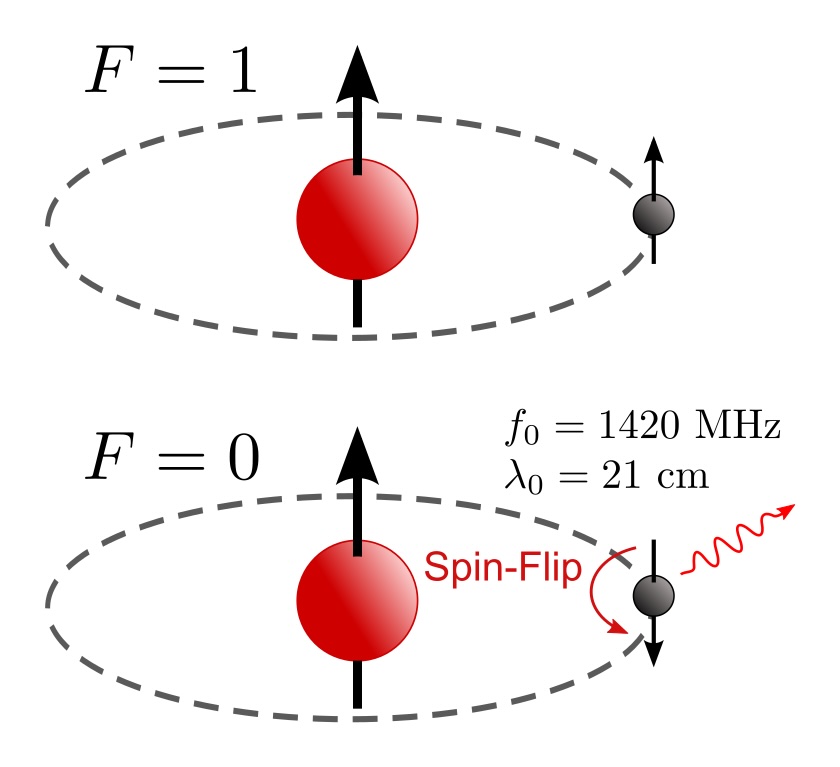
Most of the light we see every day is caused when atoms in an excited state emit light to drop to a lower energy state. If the electrons in an atom are all in their lowest energy states, then they can’t emit light. During the cosmic dark age, the neutral hydrogen and helium had cooled to their ground states, so their electrons couldn’t emit any light. But it turns out that neutral hydrogen can emit a very faint radio signal thanks to a spin interaction between its proton and electron. When the electron and proton have the same spin orientation, there is a teeny amount of energy that can be released. The electron can flip its spin and release that energy. The wavelength of the light released is about 21 centimeters, hence the name.
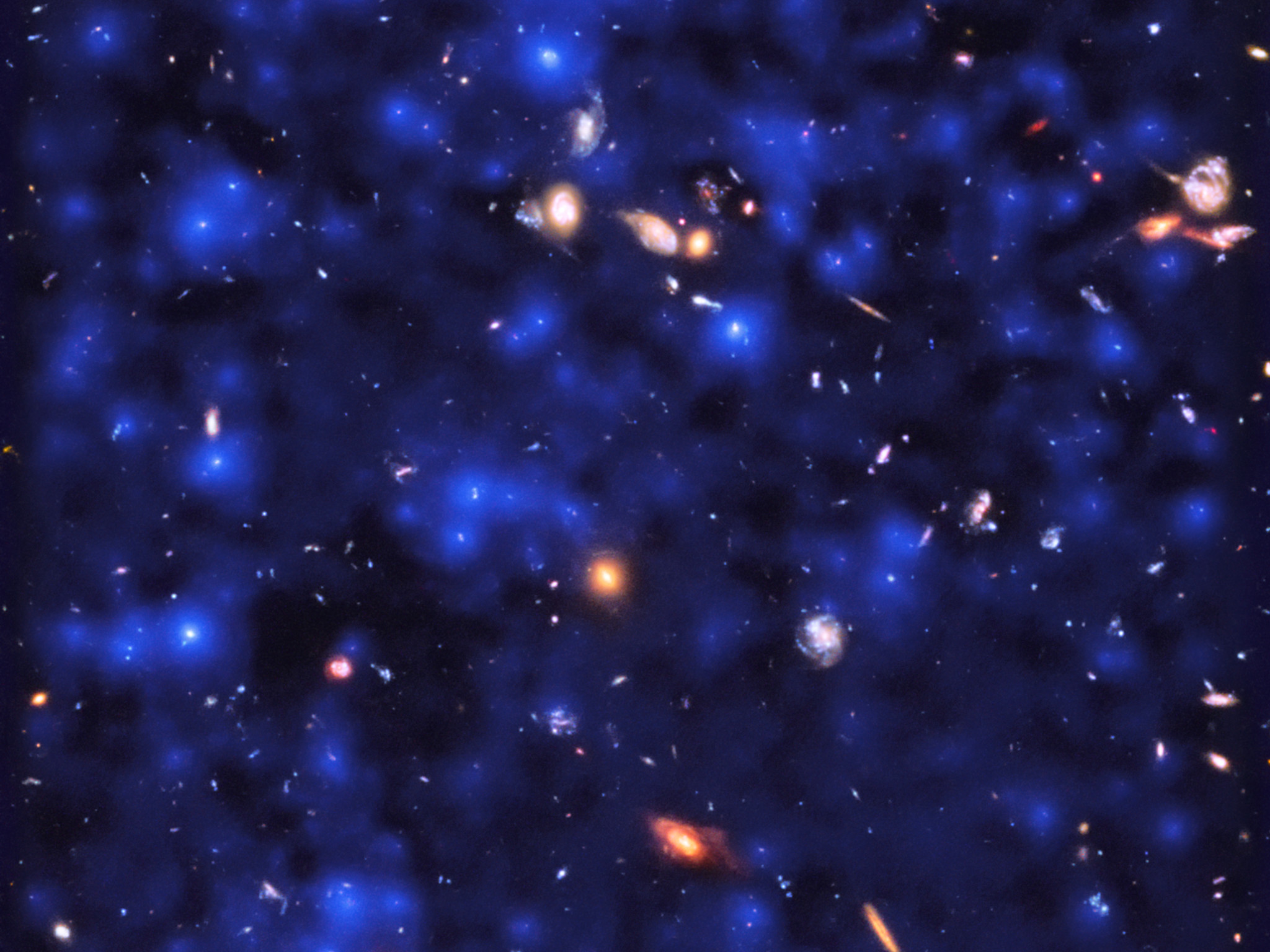
Hydrogen is by far the most abundant element in the Universe, so the 21 cm line is a great way to map the distribution of matter. And since the emitted light has a very specific wavelength, we can use things such as Doppler shift to look at how hydrogen is moving. This is how we first discovered that galactic rotation pointed to the existence of dark matter.
To study the cosmic dark ages, astronomers focus on the 21cm line during the Epoch of Reionization (EoR). It’s the period just as the first stars and galaxies were starting to form. The challenge for observing this period is that the 21cm line is not only faint but also highly redshifted. It’s only recently that we’ve had the technology to observe this period well.1 Now a couple of new studies have found the late period of the cosmic dark age was dark, but not cold.2
The team used data from the Murchison Widefield Array telescope in Western Australia. To pull the cosmological signal out of the background radio noise, they combined a decade’s worth of data to determine the hydrogen line power spectrum during the epoch of reionization. From this they found that the hydrogen of the Universe started warming up about 800 million years after the Big Bang. It was warm before the first stars ignited.
This result is interesting because it raises the question of what could have been heating it. One idea is that the warming was caused by x-rays produced by early black holes. Regardless of the source, the results rule out the “cold start” model for reionization. Even during the dark period, the cosmos was actively laying the groundwork for the stars and galaxies we see today.
Nunhokee, C. D., et al. “Limits on the 21 cm power spectrum at z= 6.5-7.0 from MWA observations.” Astrophysical Journal, vol. 989.1 (2025): 57. ↩︎
Trott, Cathryn M., et al. “Improved Limits on the 21 cm Signal at z= 6.5–7.0 with the Murchison Widefield Array Using Gaussian Information.” The Astrophysical Journal 991.2 (2025): 211. ↩︎