Blog
Astronomy for Life
6 November 2025
 Seyoun Park, Ph.D.
Astronomy isn’t cheap. Remote astronomical facilities can cost billions of dollars to build, not to mention all the training and salaries of astronomers, engineers, and technicians needed to run an observatory. And for what? To better understand a bunch of things in space that will never affect your daily life? Wouldn’t all that money be better spent on helping people right here on Earth?
I would argue that astronomy is part of what makes us human. Astronomy is older than human civilization, and the more we know about the Universe, the more we understand ourselves. If you follow me online, you likely agree with me, but suppose you disagree. Suppose you think we should stick to practical science that directly benefits people.
Okay, then here’s one for you: astronomy is helping to cure cancer.1
Cancer is a disease so pervasive and insidious that “the cure for cancer” is a meme for the greatest scientific discovery ever. The phrase has its own TV Tropes page. But there will never be a single cure for cancer.
To begin with, cancer isn’t a single disease. We’ve long known that skin cancer, breast cancer, and colon cancer have different impacts on the human body and require different treatments, and lately we’ve found that even different kinds of cancer have countless variations. Cancer is unique to individuals. So there is Bob’s breast cancer and Mary’s colon cancer. This is part of the reason some cancer treatments work for some people and not others.
Ideally we’d be able to identify the specific way someone’s cancer attacks their body, then custom tailor an effective treatment. This is where a lot of cancer research is focused these days, and we’ve made significant progress. Your immune system usually attacks the cancer cells it can find, but some cancers can use proteins to hide from your immune system. For example, in certain skin cancer melanomas, there is a protein known as programmed cell death 1 (PD-1). When PD-1 binds to another protein known as programmed death ligand (PD-L1), then the melanoma becomes harder for the immune system to detect. If a doctor knows that PD-1 is present in the melanoma, then they know that anti-PD-1 drugs can be an effective treatment. If PD-1 isn’t present, then those drugs won’t be very useful. This is known as predictive biomarking or molecular profiling.
 astropath.org
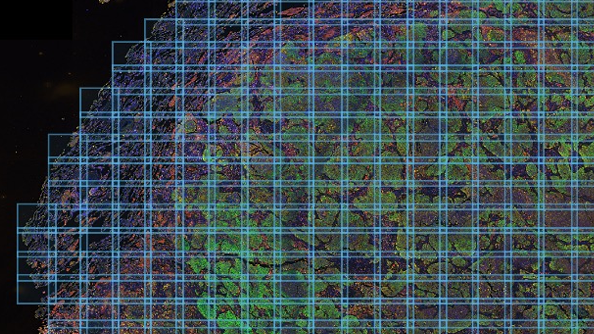
We can find these biomarkers in a sample through a process known as immunofluorescence (IF). The sample is stained with a fluorescent molecule that binds to a particular biomarker, such as PD-1. When viewed through a fluorescence microscope, the biomarker then literally glows, making it easy to identify. Of course PD-1 is just one biomarker. There are hundreds of known biomarker proteins, and the number is growing. Rather than identifying biomarkers one at a time, it would be great to do many at once. This is where astronomy comes in.2
When we look at the night sky, we don’t just see one kind of object. Nearby stars and dust get in the way of distant galaxies. Radio pulsars are scattered among white dwarfs, supernovae, and exoplanets. Everything, everywhere, all at once. Back in the old days, telescopes could only focus on a narrow patch of sky at a time, so astronomers focused on particular objects to better understand them. But these days the focus is often on sky surveys. Telescopes can scan the sky night after night, capturing giant tracts of the sky. Each night captures terabytes or petabytes of data, which astronomers then filter through to identify and study what they are interested in. An astronomer interested in binary stars filters through the same data as an astronomer interested in black holes. We’re getting pretty good at this, and it’s revolutionizing astronomy.
All of those skills we’ve learned can be applied to molecular profiling. If you make high-resolution scans of numerous samples, you can create a database of biomarker patterns, just as if they were galaxies or nebulae. And this approach isn’t individual patients. Sky surveys gather so much data that they are typically pre-filtered based on past observations. Machine learning (what the kids call AI) can be used to identify objects as the data comes in. So by building a database of molecular profiles, we can identify new patterns in cancers and their treatments.
A knowledge of the heavens is good for the soul, and it could also make your life a bit healthier.
Lest some readers worry, this post is based on a few interesting articles I came across, not a personal health issue. I’m fine. Thanks for your concern. ↩︎
Berry, Sneha, et al. “Analysis of multispectral imaging with the AstroPath platform informs efficacy of PD-1 blockade.” Science 372.6547 (2021): eaba2609. ↩︎